 | |||||||||||||||||||||||||||||||||||||||||||||||
| For education orders please call 1-877-290-8256. Welcome to the November Fourth Week Featured Article! Red Stars Geoff Gaherty, Starry Night EducationTo a casual stargazer, most stars look the same. Some are brighter and some are dimmer, but they all look much the same. All are so far away that we see them only as pinpoints of light, often twinkling because of turbulence in the Earth’s atmosphere. If you look closely at some stars, you may notice that they are different colors. Some hot young stars, like most of the stars in the constellation Orion, are bluish in color. Other old cool stars, like Betelgeuse in the upper left corner of Orion, are noticeably orange or red. Our Sun is somewhere in between, yellow-white. 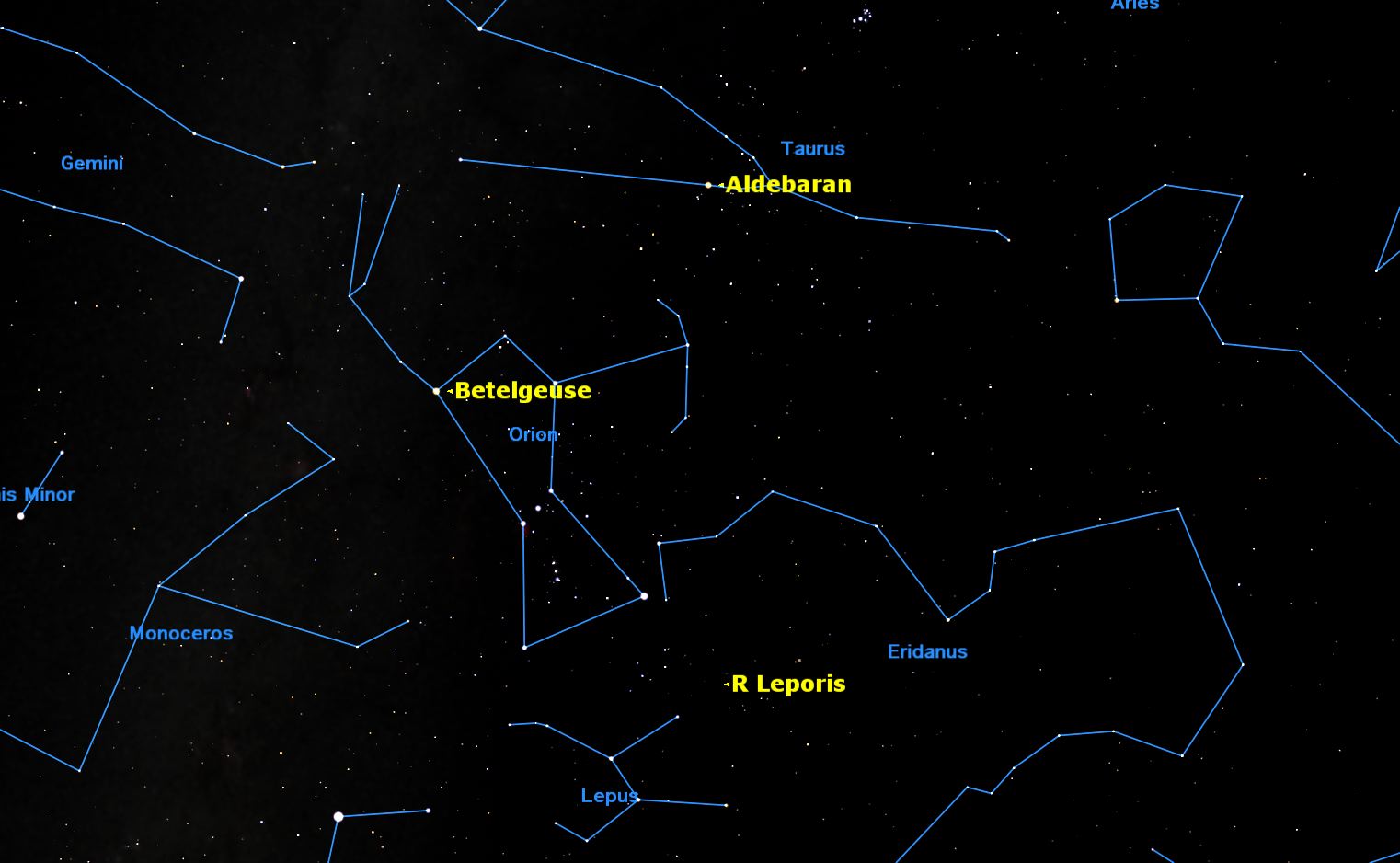
Look south around midnight to spot three of the reddest stars in the sky: Aldebaran, Betelgeuse, and R Leporis. Credit: Starry Night Software. Color differences in stars reflect the temperature of the surfaces of these stars. Most of us think of red as being hot, but if you think of a piece of iron heating in a forge, it turns slowly from dark red to white to blue. So red stars are cool and blue stars are hot. Winter evenings are a great time to study the colors of stars. Orion is a wonderful example. This is an active star-forming region in our part of the Galaxy, so most of the stars in Orion are young: hot and blue. The major exception is Betelgeuse, which is a very old star, what is known as a red supergiant. It is in a late stage of evolution, and most of its hydrogen gas has been converted to helium. It has grown huge in size in the process, a thousand times the diameter of our Sun, but it has only about 10 times the Sun’s mass. As a result it has very low density, a very tenuous atmosphere. Large spots on its surface cause it to vary in brightness. In fact, Betelgeuse is one of the most likely candidates to collapse in on itself and become a supernova in the near future. But don’t be alarmed: "near future" in the astronomical time scale could be 10,000 years. Further north in the sky is a more typical red giant star, Aldebaran in Taurus. Aldebaran looks much like our Sun will look in about 5 billion years when it has converted most of its hydrogen to helium. Aldebaran is only slightly more massive than our Sun, but has swollen to 44 times its diameter. Aldebaran doesn’t have enough mass to become a supernova. Instead it will shed its outer layers to eject a planetary nebula, like the Ring Nebula in Lyra. 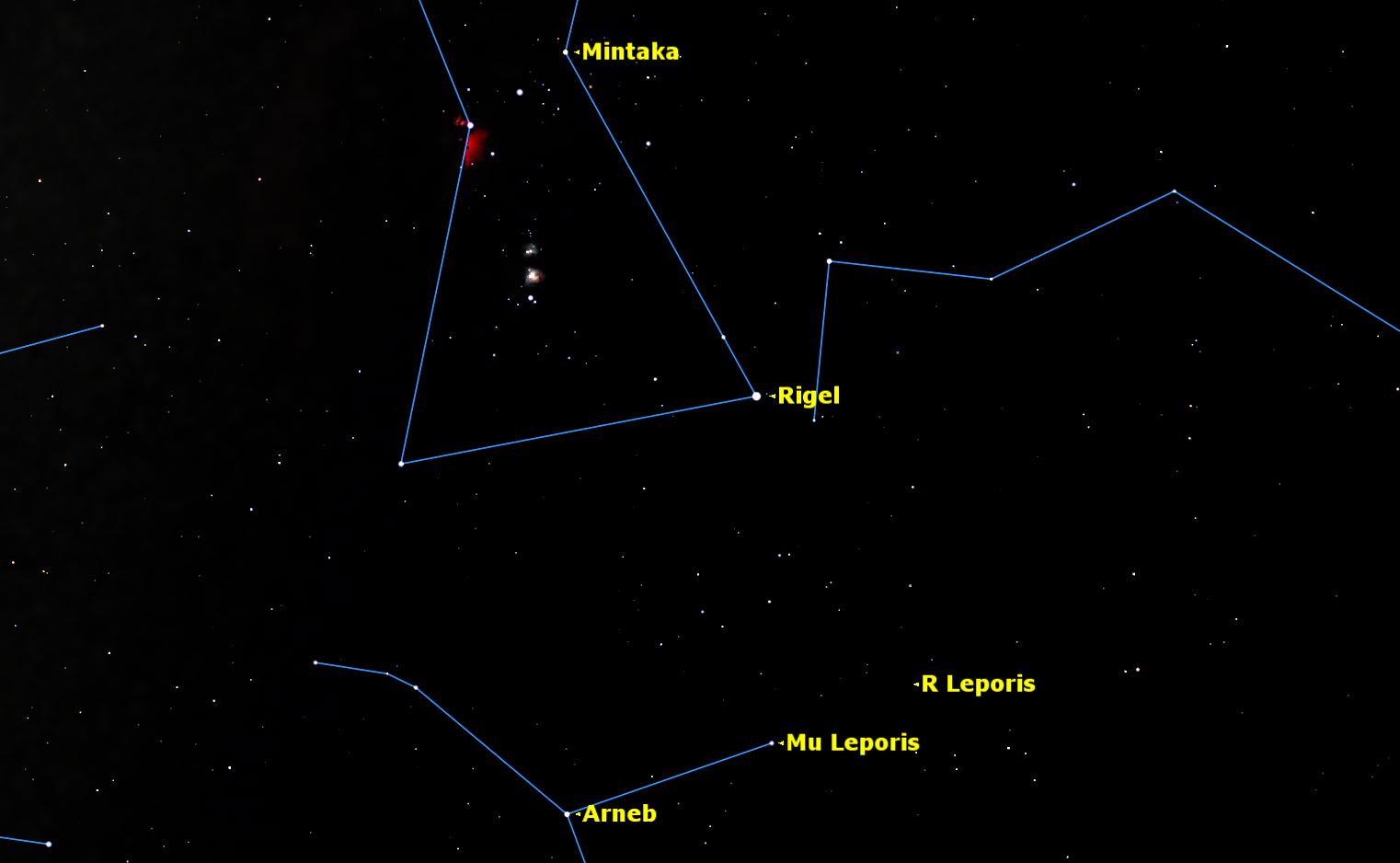
R Leporis is a 7th magnitude star, so you will need binoculars to spot it. Credit: Starry Night Software. The third red star is a very different creature. R Leporis is also a red giant, but its internal fusion processes have produced a lot of carbon. This "sooty" atmosphere causes stars like this to glow deep red. Like most red stars, R Leporis is variable in brightness, varying from 5.5 to 11th magnitude over a period of about 427 days. Now is a good time to observe it because it is close to maximum brightness at magnitude 6.5, easily visible in binoculars.
The chart shows you how to find R Leporis. You can use a line from Mintaka, the right-most star in Orion’s Belt, through Rigel, as a guide, or use Arneb and Mu Leporis in the constellation Lepus. You will know you’ve found it by its deep red color.
This star was discovered in 1845 by J. R. Hind, who described it as looking "like a drop of blood on a black field."
Having found one "carbon star," you may want to track down others. The Astronomical League has a program which challenges observers to locate a list of 100 carbon stars. |
| ||||||||||||||||||||||||||||||||||||||||||||||
© 2016 Simulation Curriculum Corp. All Rights Reserved. |
|||||||||||||||||||||||||||||||||||||||||||||||